
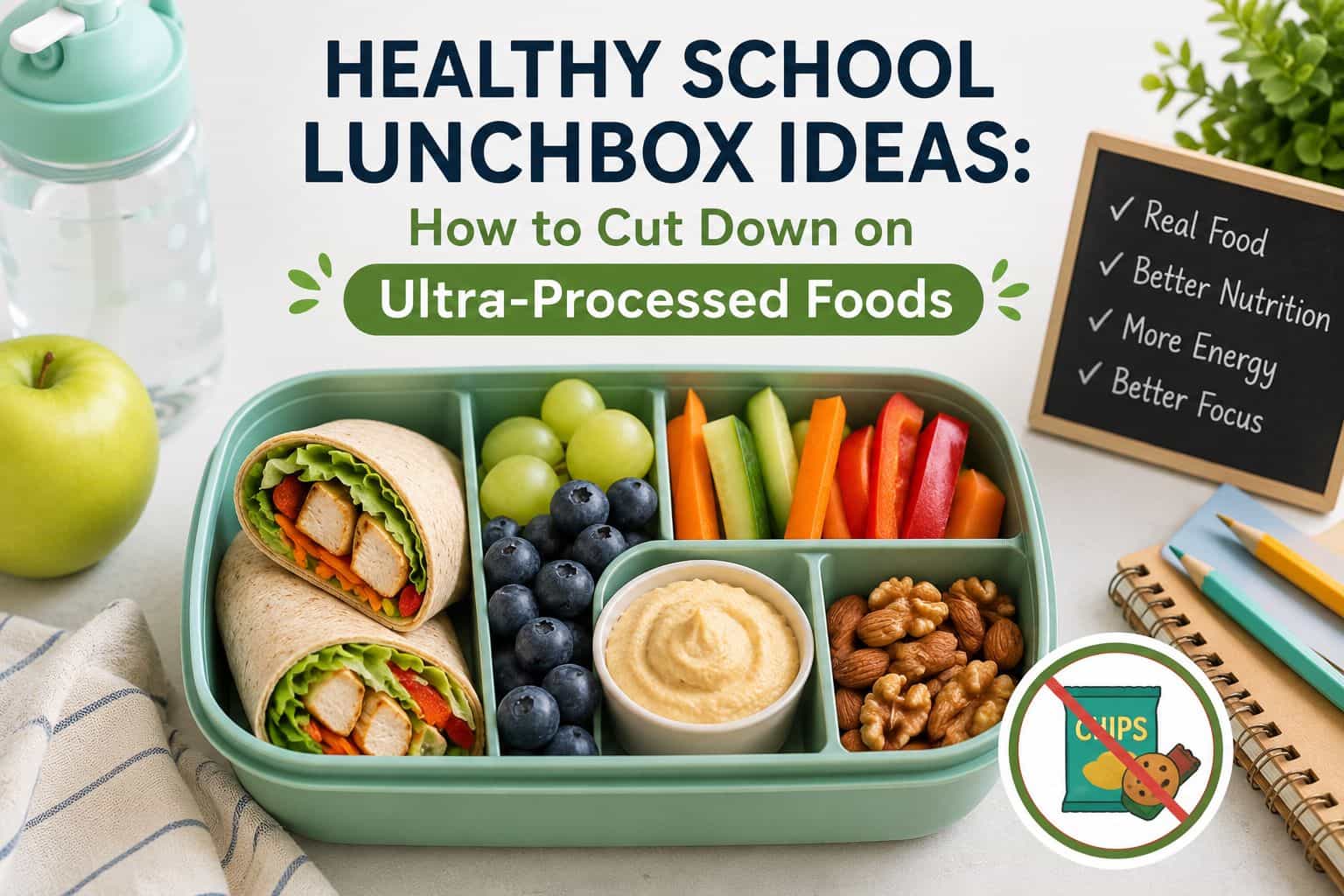
If your kid's lunchbox usually contains crackers, fruit gummies, and a sandwich on processed white bread, you've got company, and you're not doing anything wrong. Parents everywhere are searching for healthy school lunchbox ideas that go beyond convenience because ultra-processed foods (UPFs) are easy, long-lasting, and, to be frank, the kinds of things kids really like to eat. However, more studies show that children who eat too many UPFs are more likely to suffer from certain diseases when they grow older, so this guide covers practical, healthy school lunchbox ideas that don't cause a fight every day.

The Reasons Behind the Prevalence of Ultra-Processed Food in Children’s Meals
Ultra-processed foods make up most of the calories consumed in many school meals and kid-targeted packaged snacks for several reasons - they are convenient, cheap, and made especially to fit kids’ preferences. “Carlos A. Monteiro is an epidemiologist at the University of São Paulo who developed the NOVA classification of foods, where “ultra-processed” was defined,” said Dr. Carlos A. Monteiro, and added that these foods consist mostly of industrially extracted components, which are mixed with food additives to achieve taste, texture, and durability, which applies to many kid-targeted packaged snacks besides junk food.”¹
What the Literature Reveals about Kids and UPFs
"Teresa Fung, ScD, RD, Adjunct Professor of Nutrition, Harvard T.H. Chan School of Public Health," straightforwardly says it all: "it's the difference between a bag of potato chips and a potato."² Some other examples of UPFs that find their way into children's lunch boxes include baked goods sold in packages, sweetened yogurts, snack bars, and pre-made sandwiches, which often have health claims on their labels.²
Is There Actually a Problem? Evidence From Research
The Sarcopenia… Oops! Let’s Get to the Point – What About the Children?
More evidence now emerges on the connection between regular consumption of UPFs and higher chances of developing obesity; moreover, the researchers working on children's health highlight early and frequent exposure to highly sweet or salty tastes as one of the elements that may prevent children from acquiring a liking for whole foods later. In particular, the umbrella review of 2024 in The BMJ conducted by a group of researchers led by Melissa M. Lane from the Food & Mood Centre of Deakin University has shown consistent associations between the consumption of UPFs and negative health outcomes.3
It's Not About Being Perfect
Fung makes it absolutely clear that 100% avoidance is neither realistic nor necessary: "We cannot avoid processed foods totally. It's really more about opting for the less-processed food when possible."² It's really a piece of great news for parents because the point is to change the balance rather than to prepare UPF-less lunches.

Easy Swaps to Make Your Kids' Lunchboxes UPF-Free Without a Battle
Replace Processed Crackers with Raw Veggie Dippers
Processed crackers have got to be the most prevalent UPF foods in kids' lunchboxes. An easy swap would be to offer raw veggie dippers like cucumber slices, carrot sticks, or bell peppers with hummus or yogurt dip. But if your kid absolutely has to have that crunchy element, then opt for air-popped popcorn or even a couple of whole grain crackers.
Replace Processed Fruit Snacks with Real Fruits
Those fruit snacks you buy and see in ads don't contain much real fruit at all, but mostly just sugar and preservatives. Opt for fresh fruits or unsweetened dried fruit instead.
Replace Sweetened Yogurt with Unflavored Yogurt and Fruits
The flavored yogurts produced specifically for kids' consumption contain more sugar and resemble desserts than dairy products. The combination of unflavored or slightly sweetened yogurt along with berries or even a few drops of honey provides a similar taste with much fewer sugars added; the same added sugars that drive cravings later in life, not just in kids.
Replace Packaged Sandwiches with Homemade Ones Made from Whole-Grain Bread
Although convenient, pre-made sandwiches (for example, shelf-stable products like "Uncrushable") are ultra-processed. Instead, the homemade version made of whole-grain bread is possible; even the pre-made sandwich, which is frozen in advance, is preferable.
Incorporate Stealth Nutrients Rather Than Change Everything Immediately
There is no need to substitute all of the items at once. On average, the lunch that includes a protein product, whole grain, and a fruit/vegetable with only one packaged snack included usually works better because it does not provoke a child's opposition to the changes introduced abruptly.

How to Manage If Your Child Is a Picky Eater
Being a picky eater complicates the process, and according to specialists in pediatric feeding, a child’s food refusal may be linked to his/her sensory sensitivities, ADHD, and autism, among other things: easy access to processed foods, influence from other children, and lack of exposure to fresh foods.⁴ Effective strategies to try out, instead of putting your child under pressure, include:
Maintain familiar textures. If your kid eats only crunchy foods, find foods that offer the same texture but are whole (e.g., apple slices rather than apple sauce, roasted chickpeas rather than chips).
Present foods separately instead of mixing them into one meal, allowing fussy eaters to control what goes where.
Introduce new foods slowly and multiple times, rather than pushing them to finish the food. Studies about fussy eating suggest that repeated exposure is more effective than being forceful.⁴
Have your child pack their own lunches where possible.

Frequently Asked Questions
Do I have to ban all pre-packaged snacks in my child's lunch box?
No, not according to Harvard professor of nutrition science, Teresa Fung, along with other experts, who state that such an extreme approach would be both unrealistic and unnecessary, as the goal is to shift to eating more whole foods in general.²
What makes a lunchbox snack ultra-processed?
To understand whether the snack is ultra-processed or not, simply check its label. Any products that contain non-food ingredients that would not typically be available at home (such as high-fructose corn syrup, hydrogenated fats, artificial colorings and flavors) would be considered ultra-processed in accordance with NOVA classification.¹
Does my child’s limited diet to just “safe” foods pose a greater concern?
Very selective behavior regarding food choices that goes beyond normal pickiness could sometimes indicate an issue of food selectivity due to sensory processing concerns or ARFID, and might require assistance from your pediatrician or a feeding expert if it is severely limiting your child’s dietary intake.
Is it correct to consider frozen/canned products as ultra-processed?
No, not always. Frozen veggies, canned beans, and other minimally processed products preserve most of their nutrients and can’t be referred to as ultra-processed products, as described by the NOVA classification system.¹
Key Points
Removing ultra-processed products from your child’s lunch box doesn’t have to involve removing all packaged items or battling your child with each meal. Scientists such as Carlos Monteiro, who helped identify ultra-processed foods; Harvard’s Teresa Fung; and the authors of the upcoming 2024 BMJ review out of Deakin University all agree that the answer lies in one simple truth. Move the general ratio to include more whole foods when possible, but keep things familiar for fussy eaters. The incremental changes of cutting veggies instead of cracker snacks and real fruit over fruit snacks can add up much more than one big change ever will.
Sources & Research Cited
Monteiro, C. A., Cannon, G., Levy, R. B., et al. "Ultra-processed foods: what they are and how to identify them." Public Health Nutrition, 22(5), 936–941 (2019). PubMed: 30744710
Fung, T. "8 simple ways to reduce ultra-processed foods in your diet." Harvard Health Publishing (Harvard T.H. Chan School of Public Health). health.harvard.edu
Lane, M. M., Gamage, E., Du, S., et al. "Ultra-processed food exposure and adverse health outcomes: umbrella review of epidemiological meta-analyses." The BMJ, 384:e077310 (2024). DOI: 10.1136/bmj-2023-077310
Tiny Health. "Picky Eating Made Healthier: Meal Plans, Lunch Ideas, and Tips for Parents." tinyhealth.com
Leave a comment