
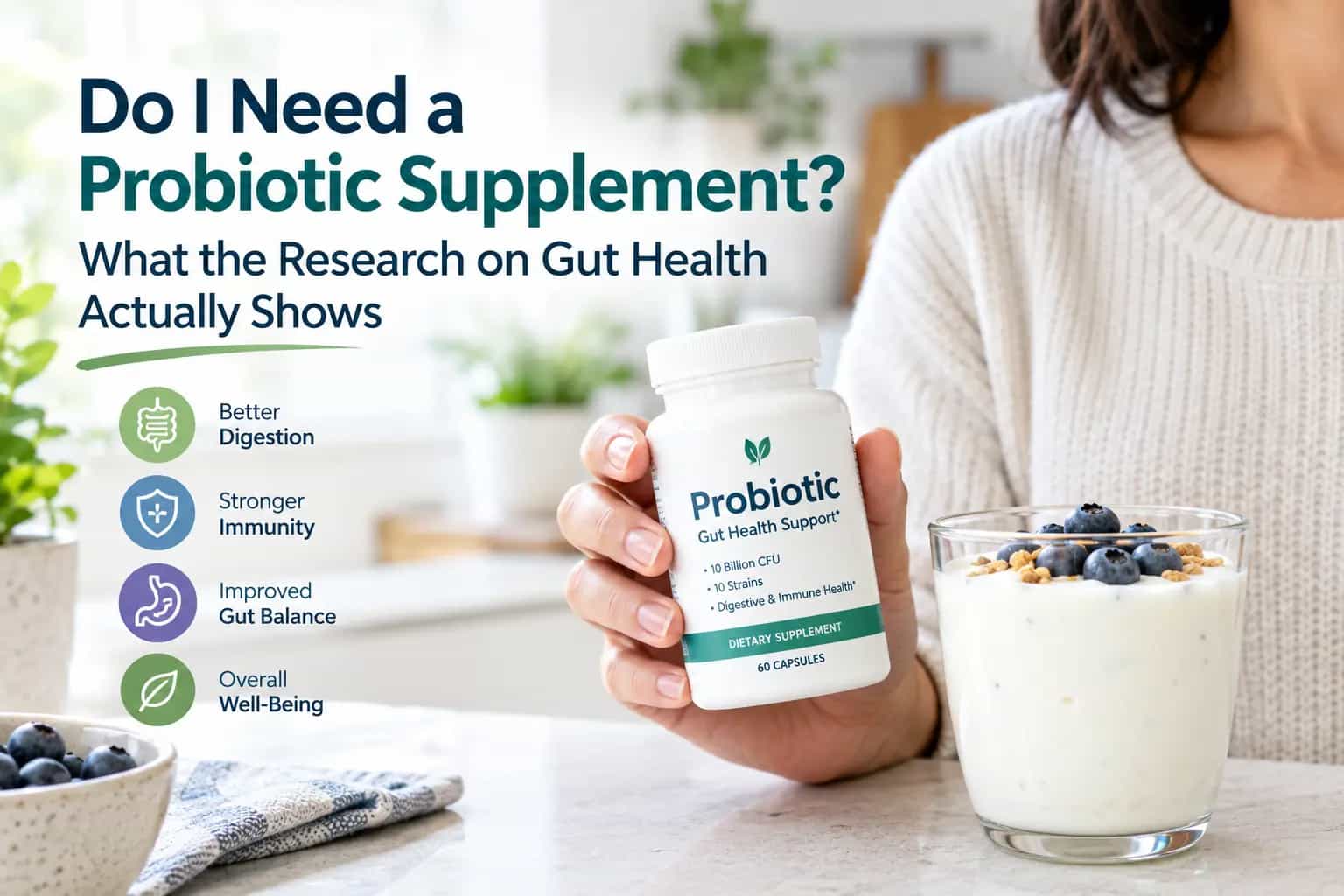
Walk down any pharmacy aisle and you'll find an entire wall dedicated to probiotic capsules, powders, gummies, even probiotic soda. The pitch is almost always the same: your gut is out of balance, and this specific blend of bacteria will fix it. It's a compelling story. According to the people who actually study the gut microbiome for a living, it's also considerably more complicated than that.
So, do I need a probiotic supplement? For most healthy people going about a normal day, the honest answer is: probably not, at least not the way the industry wants you to think. But that's not the whole story either, and there are real situations where probiotics genuinely help. If you want the broader picture on other popular gut-health claims leaky gut, fermented foods, the microbiome in general we've separately fact-checked those in our gut health myths guide.

What a Probiotic Actually Is
Before we get into whether you need one, it helps to know what the word means. According to the internationally recognized definition developed by microbiologist Colin Hill and colleagues on behalf of the International Scientific Association for Probiotics and Prebiotics, a probiotic is a live microorganism that, when given in adequate amounts, confers a health benefit on the host [1]. That last part, "confers a health benefit," is the key detail marketing often glosses over. Not every product with live bacteria on the label has actually been shown to do anything measurable once it reaches your gut.
Your Gut Microbiome Is Already Doing a Lot Without Help
Trillions of bacteria thrive inside your body’s digestive system, and the microbiome in your gut is very efficient at maintaining its equilibrium. This partly explains why the studies on introducing new bacteria through supplements have resulted in such conflicting findings. The problem is not that bacteria aren’t important. Your intestinal flora is actually quite resistant to new entrants.
Do I Need a Probiotic Supplement? Here's What the Research Says
This is where things get genuinely interesting, and where a lot of marketing claims start to fall apart under scrutiny.
For Most Healthy People, the Evidence Is Underwhelming
A landmark 2018 study out of the Weizmann Institute of Science, led by researcher Niv Zmora under immunologist Eran Elinav, gave healthy volunteers an 11-strain probiotic supplement and then directly sampled their gut lining to see what actually happened. The results were humbling for the probiotic industry: colonization was highly individual, with some people's gut linings accepting the bacteria and others essentially rejecting them, and no consistent, universal benefit emerged across participants [2]. In other words, the same product can do something for one person and almost nothing for the next, depending on their existing microbiome and biology, which is a hard thing to put on a label.
Probiotics After Antibiotics Can Actually Backfire
Here's a finding that surprises a lot of people. A companion study from the same research group, led by Jotham Suez, looked at what happens when people take probiotics right after a course of antibiotics, a very common recommendation. Rather than helping the gut recover faster, the probiotic group's natural gut bacteria took longer to return to their pre-antibiotic state compared to people who took nothing, or who received a treatment using their own banked gut bacteria instead [3]. The probiotic bacteria seemed to physically crowd the gut lining, delaying the comeback of the person's own microbial community.

Where Probiotics Do Have Solid Evidence Behind Them
None of this means probiotics are useless; it means their benefits are far more specific than "better gut health" as a blanket promise. The clearest, most consistently replicated evidence is for preventing Clostridium difficile-associated diarrhea, specifically a more serious complication of antibiotic use, not just general digestive upset. A Cochrane systematic review led by Joshua Goldenberg, pooling results across dozens of randomized controlled trials, found that probiotics meaningfully reduced this specific risk in people taking antibiotics, particularly at higher daily doses [4]. Certain strains also show modest, strain-specific benefits for people with diagnosed irritable bowel syndrome, based on systematic reviews of the clinical trial evidence, though results vary considerably depending on which strain is used [5].
The pattern that emerges from the research is fairly consistent: probiotics tend to help most when there's a specific problem to correct, like diarrhea after antibiotics rather than as a general daily wellness habit for someone who's already healthy.
What Actually Moves the Needle on Gut Health
If a probiotic supplement isn't the guaranteed fix it's marketed as, what does the research actually support?

Fermented Foods Have Real Evidence Behind Them
A well-designed 2021 study out of Stanford, led by microbiologists Justin and Erica Sonnenburg along with nutrition scientist Christopher Gardner, put this to a direct test. Over ten weeks, one group of healthy adults ate a high-fiber diet, while another added several daily servings of fermented foods like yogurt, kefir, kimchi, and fermented vegetables. The fermented-food group saw a measurable increase in gut microbiome diversity and a broad decrease in inflammatory markers, while the high-fiber group didn't show the same diversity boost over that same window, though fiber has other well-established long-term benefits [6]. It's one of the more compelling pieces of evidence that food-based sources of live bacteria can do something a supplement often can't guarantee.
Fiber Still Deserves Its Reputation
Even though the Stanford trial didn't show a fast diversity boost from fiber in ten weeks, fiber remains one of the best-supported dietary tools for feeding the beneficial bacteria your gut already has; see our guide to how much fiber you actually need if you're not sure you're getting enough. Beans, oats, vegetables, and whole grains all feed the microbes that produce short-chain fatty acids, which play a genuine role in gut lining health and inflammation control.

Diversity, Not a Single Magic Strain, Seems to Matter Most
Across most of this research, one theme keeps showing up: variety appears to matter more than any single "super strain." A gut microbiome fed a wide range of plant foods and occasional fermented foods tends to look healthier than one relying on a single daily capsule, no matter how many billions of colony-forming units are printed on the label. Researchers studying the microbiome increasingly compare it to an ecosystem rather than a machine that needs one replacement part; the more varied the inputs, from different plant fibers to different fermented foods, the more resilient and diverse the resulting community tends to be. That framing is part of why a single strain, however well studied, is unlikely to substitute for the broader dietary pattern that shapes gut health over months and years, not days.

So, Should You Take a Probiotic?
If you're generally healthy and eating a reasonably varied diet, the current evidence doesn't support probiotics as a necessary daily supplement. If you're recovering from a course of antibiotics, dealing with a diagnosed condition like IBS, or working with your doctor on a specific digestive issue, a targeted, evidence-backed strain may genuinely help; this is a conversation worth having with a doctor or registered dietitian rather than a guess at the pharmacy shelf. It's also worth remembering that supplement quality varies widely, and the strain, dose, and storage conditions on the label all affect whether the bacteria you're swallowing are even alive by the time they reach your gut.
Frequently Asked Questions (FAQs)
Q1: Do healthy people need to take a probiotic every day?
Based on current research, most healthy people with a varied diet don't need a daily probiotic supplement. The clearest benefits show up in specific situations, like preventing C. difficile-associated diarrhea during antibiotic treatment.
Q2: Should I take a probiotic while I'm on antibiotics?
This is genuinely debated. Some research suggests probiotics can help prevent antibiotic-associated diarrhea, while other research suggests they may slow your natural gut bacteria's recovery afterward. It's worth discussing timing with your doctor.
Q3: Are fermented foods better than probiotic supplements?
Current evidence suggests fermented foods like kefir, kimchi, and yogurt can meaningfully increase microbiome diversity, which is a benefit not consistently replicated with single-strain supplements.
Q4: How do I know if a probiotic supplement is actually working?
There's no simple home test for this. If you're taking one for a specific reason, like managing IBS symptoms, tracking those symptoms over several weeks is a more reliable signal than assuming any effect is happening.
Q5: Can taking a probiotic ever be harmful?
For most healthy people, probiotics are generally well tolerated with a low rate of side effects. People who are immunocompromised or seriously ill should talk to a doctor before starting one, since rare complications have been reported in those groups.
Key Points
A probiotic is only "beneficial" by definition if it's been shown to actually confer a health benefit; not every supplement with live bacteria meets that bar [1].
A 2018 Weizmann Institute study found probiotic colonization is highly individual, with no universal benefit across healthy people [2].
Taking probiotics immediately after antibiotics may actually delay your own gut bacteria's natural recovery [3].
The strongest evidence for probiotics is for specific situations like preventing C. difficile-associated diarrhea during antibiotic treatment, not general daily wellness [4].
Certain strains show modest, strain-specific benefit for diagnosed IBS, though effects vary widely by strain [5].
A 2021 Stanford study found fermented foods increased gut microbiome diversity more reliably than a high-fiber diet did over the same ten-week period [6].
Overall dietary fiber variety, plus occasional fermented foods, currently has more consistent support than any single daily probiotic capsule.
References
Hill C, Guarner F, Reid G, et al. Expert Consensus Document: The International Scientific Association for Probiotics and Prebiotics Consensus Statement on the Scope and Appropriate Use of the Term Probiotic. Nature Reviews Gastroenterology & Hepatology, 2014;11:506–514.
Zmora N, Zilberman-Schapira G, Suez J, et al. Personalized Gut Mucosal Colonization Resistance to Empiric Probiotics Is Associated with Unique Host and Microbiome Features. Cell, 2018;174(6):1388–1405.
Suez J, Zmora N, Zilberman-Schapira G, et al. Post-Antibiotic Gut Mucosal Microbiome Reconstitution Is Impaired by Probiotics and Improved by Autologous FMT. Cell, 2018;174(6):1406–1423.
Goldenberg JZ, Yap C, Lytvyn L, et al. Probiotics for the Prevention of Clostridium difficile-Associated Diarrhea in Adults and Children. Cochrane Database of Systematic Reviews, 2017.
Ford AC, Harris LA, Lacy BE, et al. Systematic Review with Meta-Analysis: The Efficacy of Prebiotics, Probiotics, Synbiotics and Antibiotics in Irritable Bowel Syndrome. Alimentary Pharmacology & Therapeutics, 2018;48(10):1044–1060.
Wastyk HC, Fragiadakis GK, Perelman D, et al. Gut-Microbiota-Targeted Diets Modulate Human Immune Status. Cell, 2021;184(16):4137–4153.



Leave a comment